
Ask anyone who rode out October 2016 and they’ll tell you the storm itself wasn’t the worst part. Hurricane Matthew came ashore up the coast, but Hilton Head still lost thousands of trees, and residents were kept off the island for days afterward. A lot of collectors figured out how to protect your car during hurricane season the expensive way that fall. After. Standing in a driveway, looking at a waterline on a rocker panel.
Living on a barrier island is a trade. You get marsh light in November, Sea Pines in the shoulder season, and backroads out past Bluffton that were drawn for a well-sorted six-cylinder. The bill comes due from June 1 to November 30, when a graphic on a weather site can rearrange your entire week. If a 911, a C8, or a numbers-matching E-Type lives here, that graphic is your problem too.
September Is the Month Nobody Relaxes
Peak Atlantic activity lands right around September 10. That isn’t folklore, it’s the climatological average, and it’s why our members start asking about storage in August instead of November. Beaufort County’s barrier islands sit in Evacuation Zone A, which is the first zone called, every single time.
Then there’s the geography. Hilton Head has one road off: US-278 across the bridges toward Bluffton and SC-170. Put the island’s population on that road at the same time and a twenty-minute run becomes a four-hour crawl with the A/C off to save fuel. The Cross Island Parkway is excellent for getting you to the bridge. It is not an exit.
Saltwater Doesn’t Care What the Car Is Worth
Wind gets the headlines. Water writes the checks. Surge pushing up Broad Creek and in from Port Royal Sound carries salt, and salt is the one thing a wiring harness cannot negotiate with. Four inches in the footwell is enough to do it. Modules under the seats, seatbelt pretensioners, the body control module. They don’t dry out. They corrode quietly and fail in February, and nobody connects the failure back to a storm five months earlier.
The paperwork damage is worse than the mechanical damage. A flood brand on a title turns a six-figure car into a project with a story attached, permanently, in every database a future buyer will check. There is no detailer, no dry-out service, and no insurance adjuster who can undo that.
Know What the Cone Actually Means
Most people treat a watch and a warning as two shades of the same color. They aren’t, and the gap between them is your whole timeline. The National Hurricane Center issues a hurricane watch and a hurricane warning at 48 hours and 36 hours respectively, ahead of the arrival of tropical-storm-force winds.
Here’s the part that matters for a collection: by the time a warning is posted, you are not moving cars. The bridges are loaded, the enclosed transport companies stopped answering two days ago, and the last thing you want is an open trailer on US-278 in a crosswind. The real deadline for a car owner on this island isn’t 36 hours. It’s the moment Beaufort County first appears inside the five-day cone, roughly 96 to 120 hours out, while the roads are still empty and somebody still picks up the phone.
How to Protect Your Car During Hurricane Season: The 96-Hour Plan
Write this down in March, not while you’re watching radar in a bathrobe.
- 96 hours out. Decide which cars move and in what order. If you have four and room for two, that call gets made now, on a calm Tuesday, not in a driveway at midnight.
- 72 hours out. Fuel everything to full, including the trailer tow vehicle. Check tire pressures on the cars that haven’t turned a wheel since spring. Confirm your storage destination is expecting you.
- 48 hours out. Photograph every car inside and out, wide shots and detail shots, and get the odometer and VIN in frame. Email the photos to yourself so they live somewhere other than the phone in your pocket.
- 36 hours out. Move the cars that are moving. Pull anything you’d hate to lose out of the cabin and the trunk: documents, tools, the original build sheet in the glovebox.
- 24 hours out. You should be finished and thinking about your house, not your garage.
If a Car Has to Ride It Out at Home
Sometimes there’s no room and no time. Hagerty’s write-up on storm prep and evacuation planning is worth reading start to finish, and the short version goes like this.
- Park against an interior wall, as far from the garage door and from any tree that could reach the roof as the footprint allows.
- Put the car on jack stands. Every inch you gain is an inch of harness that stays dry, and neighborhoods that have never flooded flood eventually.
- Disconnect the battery. A shorted harness sitting in standing water is how a survivable flood becomes a fire.
- Fold or remove antennas and mirrors, fit a soft cover, then a tarp over the top of it.
- Anchor anything buoyant: fuel cans, the compressor, a rolling tool chest. A floating toolbox will find your door skin.
- Brace the garage door with two-by-fours. That door is the largest flat sail on most houses here, and once it goes the roof is next.
What a Real Vault Actually Buys You
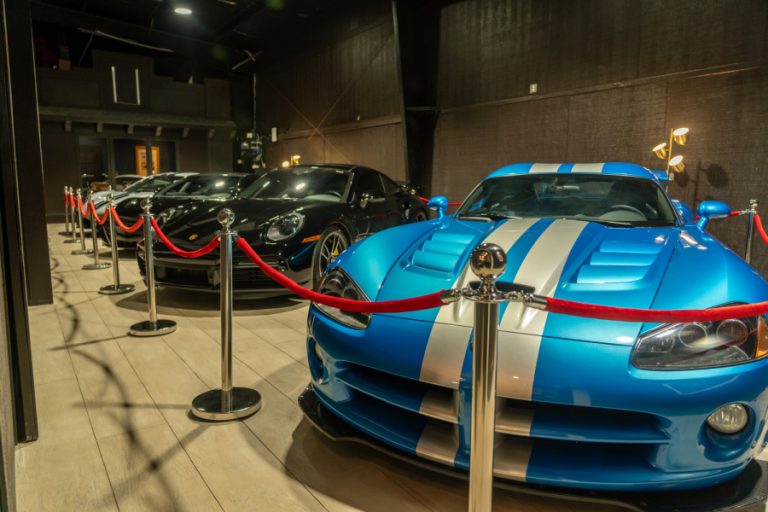
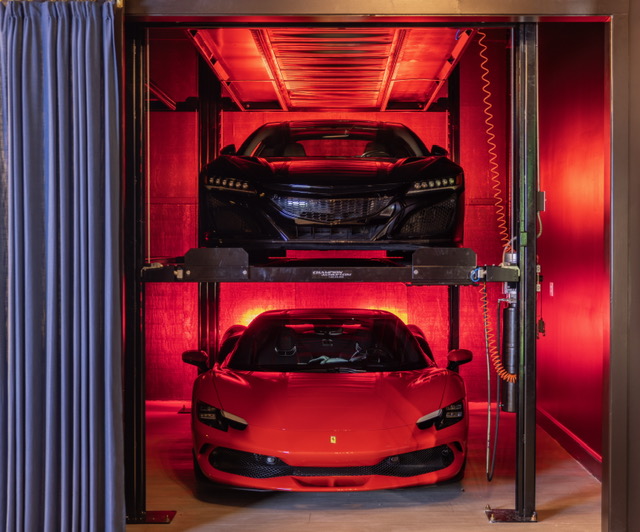
This is the part our members simply don’t do, and it may be the quietest luxury we offer. Cars stored at Vehicle Vault Club sit inside a climate-controlled, monitored building behind a discreet members-only entrance, under a commercial roof, on a slab poured to carry lifts rather than on a residential subfloor over a crawlspace. When a system gets a name out past Bermuda, the cars are already sitting where you would have evacuated them to. There is no plan to execute.
Humidity is the same fight, slowed down to a year-round pace. Lowcountry summer runs 80 to 90 percent relative humidity for weeks on end, and salt air off the Sound works on brake rotors, chrome, and leather whether or not a storm ever forms. Stable temperature and stable humidity are what keep a stored car from aging faster than a driven one. That’s the everyday argument for a private automotive social club with real climate control, and the hurricane is only the version of the argument that makes the news.
The other thing you get is company. September on this island is a long month of refreshing forecast maps. It’s a better month when you’re doing it in the lounge with people who own the same problem, comparing notes on who’s already moved what, with your cars fifty feet away behind a locked door.
Make the Call on a Quiet Tuesday
Nobody has ever regretted moving a car too early. Plenty of people on this island have regretted the opposite, and most of them will tell you the story unprompted if you bring up 2016. If you’ve been meaning to settle where your cars go the next time Beaufort County lands inside the cone, settle it now, in the off-season, while it’s a decision instead of an emergency.
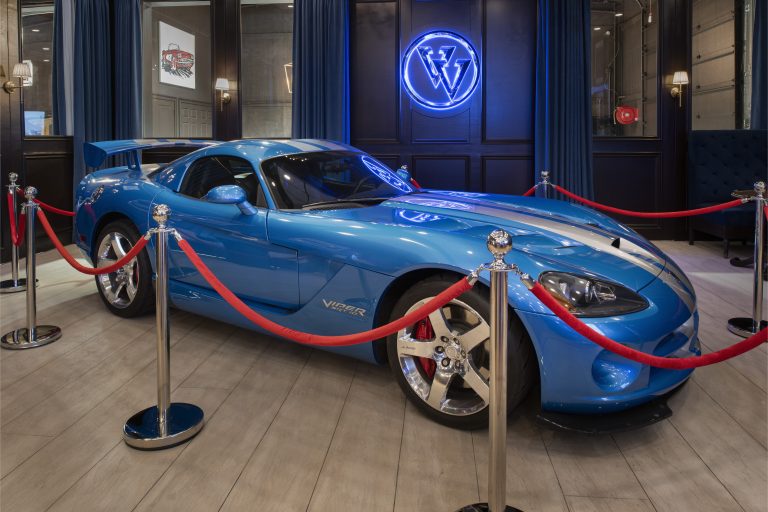
Come see the building. Have a drink in the speakeasy, look at what’s parked in the bays, and ask our members what their storm plan looked like before they joined. Then Join The Vault and give yourself one less thing to watch this season.